01 Massive Power & Velocity
Increase your serve and groundstroke velocity without swinging harder or wearing out the arm.
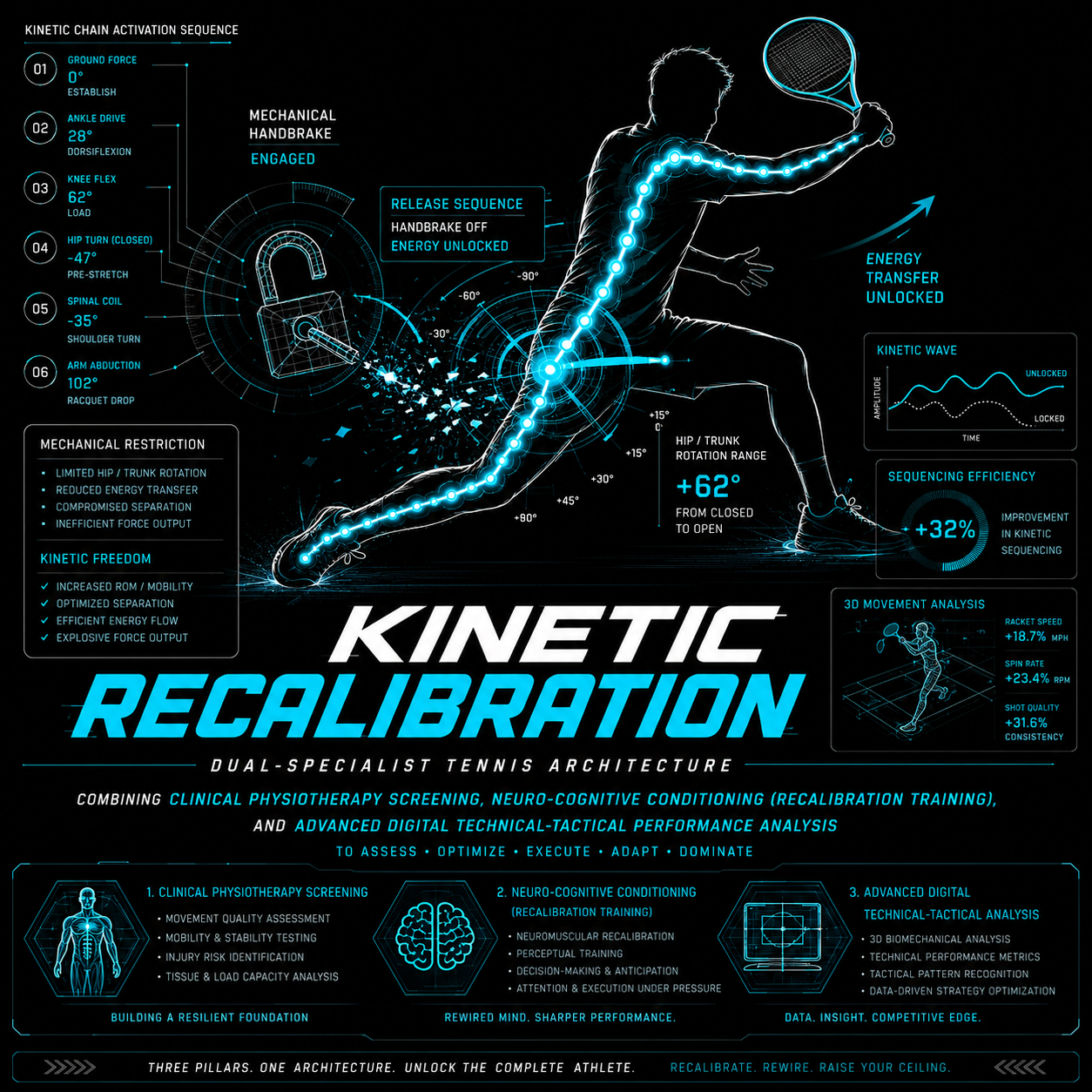
Force generation from the hips and trunk by utilizing the Ground Reaction Force (GRF) generating effortless racket head speed.

Under intense pressure, your brain’s survival center (the amygdala) takes control. It signals your body to breathe faster (above 20 breaths per minute).
In an untrained player, this physiological surge triggers a cascade:
• Visual Breakdown: Gaze drifts rapidly, shortening the "Quiet Eye"—the critical split-second visual fixation needed to track incoming speed and spin accurately.
• Physical Rigidity: Fast breathing alters blood chemistry (inducing mild respiratory alkalosis), restricting blood flow to the limbs, causing early fatigue and stiff, late shot preparation.
By pairing intentionally induced physiological stress with open-loop tactical decisions, Recalibration Training conditions the brain's executive hub (the dorsolateral prefrontal cortex) to keep top-down control over the amygdala.
Rather than letting physical arousal trigger panic, the brain learns that a racing heart and rapid breath are simply background noise. Over time, this neural adaptation uncouples physical stress from cognitive collapse.
Visual Gaze
From fragmented focus; eyes dart around under pressure to sustained "Quiet Eye" (>100 ms fixation on target/ball).
Autonomic Control
From slow heart rate recovery between intense points to accelerated Heart Rate Recovery (HRR).
Biomechanics
From late preparation, tight shoulders, trunk collapse to early positioning and stable core rotation.
Ball Striking
From inconsistent contact point; passive short balls to consistent forward contact point and heavy ball pace.
When an athlete lacks joint mobility—such as restricted thoracic spine rotation or hip internal/external rotation deficits—the brain compensates by borrowing force from neighboring joints.
In tennis, a player unable to rotate through the hips will over-rely on the lumbar spine, shoulder, and forearm to generate racket head speed. This leads directly to performance plateaus and overuse injuries like rotator cuff strain, medial elbow pain, and Achilles tendinopathy.
Efficient athletic movement relies on sequential kinetic chain coordination. Force generation must flow from the ground up.
To protect developing joints and maximize energy transfer, at least 70% of total stroke force must be generated by the hips and trunk/core, leaving less than 30% to be contributed by the arm and upper extremity.
Ground Reaction Force (GRF) utilized correctly through the core produces 3 to 8 times more force than localized muscle contractions alone.
Traditional footwork relies heavily on active muscular jumping or pushing off the trail leg. Modern athletic development trains gravity-based movement initiation:
• Center of Mass (COM) Unweighting: Instead of pushing off, the athlete rapidly "drops" their body weight to allow gravity to initiate first-step direction changes.
• Benefits: Reduces unnecessary muscular pre-loading, decreases Achilles tendon strain, accelerates first-step reactions, and expands court coverage.
Competitive Juniors (Ages 11–16): Peak Height Velocity (PHV)
The period between ages 11 and 16 marks the onset of puberty and Peak Height Velocity (PHV), making professional movement intervention a critical necessity
Senior Players (40+): Longevity & Structural Maintenance
Senior players frequently suffer from accumulated "mechanical handbrakes"—chronic lower back stiffness, reduced hip mobility, and shoulder impingement caused by lifestyle and age. Re-establishing hip-driven kinetic chain mechanics releases strain on aging joints, eliminating pain and restoring high-level velocity.
Increase your serve and groundstroke velocity without swinging harder or wearing out the arm.
Force generation from the hips and trunk by utilizing the Ground Reaction Force (GRF) generating effortless racket head speed.